
Automotive Sector
Stainless steel in vehicles falls into two families: heat-resistant (exhaust) and decorative. Their grade systems and acceptance criteria differ, and mixing them costs money or causes failure.
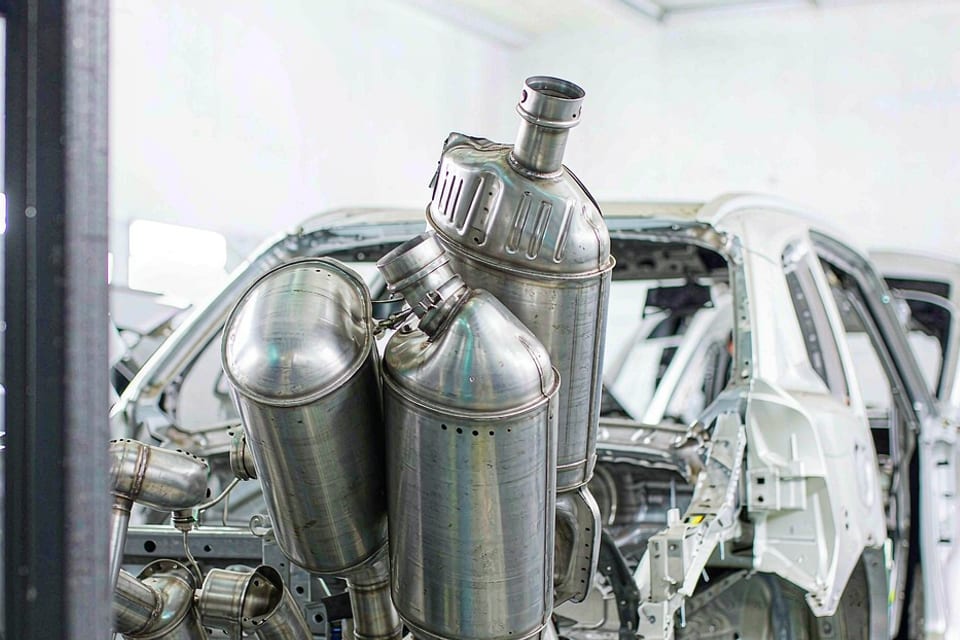
Typical Parts and Material Selection
| Part | Grade | Surface / Size | Watch Out For |
|---|---|---|---|
| Exhaust manifold / downpipe | 409 / 441 | 2B / 1D, 1.2–2.0 mm | High-temperature oxidation resistance, thermal fatigue |
| Muffler / exhaust pipe | 409 / 436L | 0.8–1.5 mm | Condensate corrosion |
| Trim / bright profiling | 304 / 430 | BA / 8K, 0.3–0.8 mm | Surface class, no cracking on bending |
| Fuel tank / bracket | 304 / 441 | 1.0–2.0 mm | Formability, spot weldability |
| Seat frame | 301 / 304 | High-strength sheet 0.5–1.2 mm | Yield ratio, fatigue |
Three Real Constraints in This Sector
Exhaust Is Not "the More Expensive the Better"
409 is titanium-stabilized, economical and adequate; 441 adds Nb+Ti for higher temperatures. Both mistakes are common: 304 in exhaust cracks at welds due to thermal expansion, 409 in a hot section flakes.
Deep Drawing Depends on the r Value, Not Hardness
Stamped parts need high r and low Δr. The same grade from different rolling sequences behaves very differently — always run a forming trial before the batch, don't just read the mill certificate.
Electrode Life Determines Takt Time
Stainless steel has high strength and low conductivity, so spot welding electrodes wear quickly. Plan electrode changes by weld count and check incoming oil film and roughness.
Related Products
Need a Quote or Technical Support?
Send us the component, grade, dimensions, quantity and destination port — we respond with FOB / CIF within 24 hours.